The document was unsealed on a Wednesday, as these things typically occur. After years of confidential legal proceedings, a federal judge in White Plains, New York, agreed to release a handwritten note that was long thought to be Jeffrey Epstein’s alleged suicide message. This decision quickly reignited a tale that the public has never really moved on from. The actual note is brief and not signed.
“It is a treat to be able to choose one’s time to say goodbye.” is the line that has dominated news. Another sentence is jagged and almost dramatically frustrated. “They investigated me for months — FOUND NOTHING!!!” Although the cadence is clear, the lack of a signature has already left the document with an incomplete, disputed quality that will take years to fix.
| Epstein Note Unsealing — Snapshot | Details |
|---|---|
| Document Type | Alleged handwritten suicide note |
| Attributed Author | Jeffrey Epstein |
| Signature on Note | None |
| Person Who Found It | Nicholas Tartaglione, Epstein’s cellmate |
| Tartaglione’s Background | Former police officer, convicted of quadruple murder |
| Tartaglione’s Sentence | Four consecutive life sentences |
| Location of Discovery | Metropolitan Correctional Center, Manhattan |
| Date of First Suicide Attempt | July 2019 |
| Date of Epstein’s Death | August 2019 |
| Cause of Death (Official) | Suicide, per NYC Medical Examiner |
| Judge Who Released Document | US District Judge Kenneth Karas |
| Petitioning Outlet | The New York Times |
| Court Location | White Plains, New York |
Nicholas Tartaglione, a former police officer serving four consecutive life sentences for a quadruple murder connected to a 2016 narcotics investigation, is the cellmate at the center of the narrative. According to court documents, he was the one who discovered Epstein unconscious in their cell at the Metropolitan Correctional Center in Manhattan following a prior attempt at suicide in July 2019, weeks before Epstein was ultimately discovered dead.
According to Tartaglione, he obtained the note following that earlier event. In part to guard against possible accusations that he had assaulted Epstein, he turned it on to his own legal team. In response, the lawyers employed handwriting specialists to verify its validity. These analyses have not been released to the public.
It is worthwhile to consider the legal process by which the document came to light. As part of Tartaglione’s appeal, the message was sealed under attorney-client confidentiality. Last week, the New York Times revealed its existence and formally asked the court to release it.
The note was presented in conjunction with the underlying criminal proceedings, therefore US District Judge Kenneth Karas, who has overseen Tartaglione’s criminal case for years, decided that it qualified as a judicial record subject to the public’s right of access. Strange outcomes are often the consequence of such a verdict. A document that was initially intended to bolster a defense hypothesis is now being used as public evidence in a far more extensive and complicated discussion.
The discrepancy between the official record and the public’s intuition is what makes the unsealing truly peculiar. In 2019, the medical examiner in New York City declared Epstein’s death to be a suicide. Prison assessments, oversight reports, and federal investigations have all come to similar conclusions.
However, the narrative has not been resolved. The questions are no longer genuinely about the cause of death, as anyone who has followed the political fallout from Epstein’s case can see. They are about the people he knew, the goods he trafficked, and the networks of wealth and influence that survived him. Even if the note is later verified, none of that is resolved by it. Most likely, it can’t.
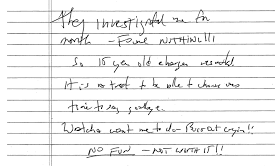
Reading the language ascribed to him is very uncomfortable. The exclamation points. The combative “NO FUN — NOT WORTH IT!!” The feeling of someone writing what might have been his final words while attempting to convey confidence in a tiny concrete room.
If the note is authentic, it reads like a man performing for a crowd he is no longer able to reach. If not, the issues of what was going through that cell and why become more complex. Regarding the unsealed text, the Justice Department has not yet responded. The Guardian has taken the appropriate precaution by stating that it has not independently confirmed the letter’s authorship.
The larger rooms where this story still exists are difficult to ignore. Significant settlements have been reached against banks and erstwhile associates in the years-long legal lawsuits launched by Epstein’s victims. Ghislaine Maxwell is still incarcerated in federal prison and is still filing an appeal.
The public’s perception of Epstein as a person whose entire network was never fully revealed has been cemented by books, documentaries, and parliamentary hearings. A tiny, peculiar artifact at the periphery of that much greater narrative is the unsealed note. What authentication yields and whether there is the political will to continue posing the more difficult questions will determine whether it ultimately becomes a footnote or something more significant.