In Ohio, the term “Level 3 snow emergency” is not disregarded. It hits hard, slicing through regular warnings and lighthearted weather talk, indicating that the situation has moved from inconvenient to actually dangerous.
Level 3 is not a recommendation, unlike forecasts or advisories. This is a difficult pause, a civic reset that calls on the entire county to take a collective step back, much like a swarm of bees automatically withdrawing to defend the hive when the weather turns bad.
| Category | Details |
|---|---|
| Alert Type | Level 3 Snow Emergency |
| Issued By | County Sheriffs in Ohio |
| Meaning | All roads closed to non‑emergency travel |
| Legal Impact | Possible citation or arrest for unnecessary driving |
| Typical Triggers | Heavy snow, drifting, extreme cold, low visibility |
| Recent Catalyst | Winter Storm Fern (January 2026) |
| Reference | Ohio County Sheriff Offices (official notices) |
Winter Storm Fern layered snow more quickly than plows could realistically chase it, and temperatures dropped to the point where even treated roads were unreliable in recent days, escalating counties throughout Ohio to Level 3.
Traction becomes theoretical at that point. Automobiles become obstacles instead of tools, and one stalled car can spread, obstructing ambulances, tow trucks, and plows in a chain reaction that no amount of self-assurance can reverse.
The snow emergency system in Ohio is remarkably straightforward. Level 1 advises caution. Only necessary travel should take place, according to Level 2. Level 3 completely closes the roads, allowing only emergency responders and vital workers who maintain public safety, utilities, and hospitals to move.
When information overload turns into a risk in and of itself, that clarity is especially helpful. You can’t guess what Level 3 means, and you can’t read fine print while looking at a white windshield.
The decision is made by county sheriffs, not the state or transportation authorities. When the threshold is exceeded, they take decisive action after consulting forecasts, road crews, emergency managers, and real-time reports.
That local authority works amazingly well. Ohio’s system enables decisions to represent actual conditions on the ground rather than averages on a map, as conditions can differ greatly between counties.
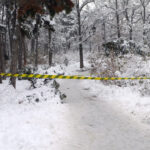
The problem is not just snow by the time Level 3 is announced. Drifts are reshaped more quickly by wind than by plows. Fresh accumulation is covered by ice. Sometimes visibility collapses in a matter of seconds.
It’s not heroic to drive during those times. The odds quickly compound, and it is mathematically risky.
The rarity of Level 3 is what makes it particularly startling. The declaration gains a seriousness that dispels skepticism because many Ohioans live for decades without witnessing it activated in their county.
Without discussion, businesses close. Schools change formats or discontinue entirely. The steady hum of traffic fades to almost nothing, and delivery apps become silent.
Neighborhoods can hear the shift. Snow absorbs sound, and when there are no engines, the streets seem unusually far away, as if everyday life’s volume knob has been abruptly lowered.
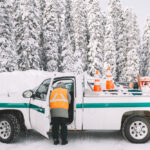
A lone salt truck drove by my window, its engine filling the room for a moment before the silence returned, heavier and more serene. That was when I noticed that quiet the most.
It’s common to misunderstand enforcement during Level 3. Most sheriff’s offices prioritize discretion, focusing on preventing harm rather than punishing curiosity, even though citations and arrests are possible.
Residents and authorities have a greater level of trust as a result of that strategy. When people understand that staying off the road is an act of cooperation rather than surrender, the system functions best when they comply voluntarily.
That change was evident from the responses on social media during the most recent Level 3 declarations. Many feeds were filled with pictures of empty highways, reminders to stay at home, and appreciation for plow drivers who put in long shifts, rather than complaints.
Ohio has significantly improved its capacity to withstand these disruptions over the last ten years. The economic shock that used to accompany severe winter shutdowns has been greatly lessened by remote work infrastructure, flexible scheduling, and faster communication.
Virtual instruction offers continuity to educational institutions. Email takes the place of commuting for offices. What used to feel like paralysis now feels more like adaptation.
This resilience also applies to emergency preparation. Counties can improve the efficiency of plows, clear roads more quickly, and restore safe movement sooner by limiting traffic early.
Patience is rewarded in this feedback cycle. Less traffic means fewer collisions. Faster reaction times result from fewer accidents. The system self-corrects.
It is a different calculus for essential workers. In order to maintain coverage, nurses, utility crews, and first responders frequently sleep on the scene or work long shifts.
Their presence serves as a reminder of the original purpose of Level 3. Some people must be able to access roads that are closed to most, and every extra car lessens the importance of that.
Extreme cold, according to weather experts, makes recovery even more difficult. At very low temperatures, de-icing materials lose their effectiveness, making snow removal a slower, more methodical process.
Early restraint is a particularly novel tactic because of this reality. Level 3 seeks to avoid gridlock completely rather than responding to it once it occurs.
Although history indicates otherwise, critics occasionally portray the declaration as being overly cautious. When warnings were disregarded, rather than when they were heeded, major winter disasters typically followed.
During these intervals, a social dimension also becomes apparent. Neighbors look out for each other. Driveways are shared. Sidewalks are cleared for accessibility as well as convenience.
One is prompted to make a subtle adjustment by the enforced slowdown. Work loses its urgency. Safety becomes clearer. Without arguing, priorities swap places.
Ohio counties have improved their ability to combat false information during storms by coordinating messages between sheriff offices, local media, and city governments.
Maintaining consistency is important. Trust arises when the same instruction is repeated by each channel.
There is a limit to Level 3. Instead of restoring movement all at once, it is made to lift as soon as circumstances permit, stepping down to Level 2 and then Level 1.
At that point, traffic resumes, routines resume, and the silence turns back into everyday noise.
The recollection of how easily a whole area adapted when instructed to stop, rather than the inconvenience, is what endures.
Ohio’s Level 3 snow emergency provides an unexpectedly hopeful lesson in a time often characterized by fragmentation: collective restraint can be not only feasible but also remarkably successful when signals are clear and a common goal is understood.