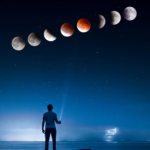
On some nights, the sky appears to hesitate before darkening shortly after the sun sets. It maintains a subtle glow, a sort of subdued change from day to night. At this point, the six-planet parade quietly, almost hesitantly, starts to emerge.
Mercury, Venus, Saturn, Jupiter, Uranus, and Neptune form a wide arc over the western sky near the end of February 2026. Contrary to what some people might think, it’s a looser, more organic line that resembles pearls strewn along an imperceptible curvature. Although it may not be as uncommon as it seems at the time, this arrangement is uncommon.
Key Information About the Six-Planet Alignment (2026)
| Category | Details |
|---|---|
| Event Name | Six-Planet Parade |
| Planets Involved | Mercury, Venus, Saturn, Jupiter, Uranus, Neptune |
| Peak Dates | February 27–28, 2026 |
| Best Viewing Time | 30–60 minutes after sunset |
| Direction | Western horizon |
| Visible to Naked Eye | Venus, Jupiter, Saturn, Mercury |
| Requires Equipment | Uranus, Neptune |
| Best Conditions | Dark skies, low light pollution |
| Viewing Tools | Binoculars, telescope, sky apps |
| Reference Website | https://solarsystem.nasa.gov |
Venus is the first item that draws attention when one is in an open field far from city lights. Unlike a star, it doesn’t blink. Low in the horizon, it shines steadily, almost obstinately brilliant. Jupiter can be seen nearby; it’s not as strong but still noticeable. These two anchors are the simplest to locate, the ones that catch your attention before you even recognize what you’re looking at.
Finding planets without a telescope has a subtle allure. It seems instantaneous, almost intimate. Under the correct circumstances, Saturn and Mercury can also be seen with the unaided eye; however, they are located closer to the setting sun. Here, timing is crucial. If you wait too long, they will vanish. For the simple reason that they look too late, a lot of people can miss this alignment.
The viewing window is limited, lasting between thirty and sixty minutes after sunset. The planets then start to set, one by one disappearing beyond the horizon. They simply evaporate, silently, as if nothing out of the ordinary had occurred; the sky does not herald their departure.
The scene is enhanced for those who bring binoculars or a telescope. Neptune and Uranus appear, pale and far away. They are not as noticeable as Jupiter or Venus. Rather, they call for patience—careful inquiry, minor modifications. Finding them is more like discovering than observing. That procedure has a certain sense of fulfillment.
Apps for astronomy, such as Star Walk or Stellarium, can assist in precisely locating every planet. However, there is a certain amount of unpredictability even with technology. Depending on time, location, and atmospheric conditions, the sky changes slightly. One evening’s clarity may be clouded the next.
It’s difficult to ignore how this experience differs from the majority of contemporary entertainment. No screen, no playback, and no assurance. You go outside, gaze up, and hope that everything is in harmony, both literally and symbolically.
Planetary alignments have always had some symbolic significance. They were frequently seen as signals or omens by ancient societies, who deduced significance from their patterns. These days, the explanations are more grounded and the science is more transparent. However, the feeling of awe hasn’t completely vanished.

There is a brief but visible moment when the size of the solar system seems more real when you see several planets appear in the same area of the sky. These are not far-off concepts. From a backyard or a peaceful roadside, they are things traveling along predictable routes.
However, the alignment is not flawless. The planets’ spacing can seem uneven, and they don’t form a straight line. Why expectations frequently favor symmetry when reality is more organic is still a mystery. Maybe it’s only people’s perceptions of the universe’s order.
In order to prevent light pollution from washing out the darker objects, the finest viewing spots are typically found outside of cities. There must be no trees or structures obstructing the view in order to have a clean western horizon. It may surprise you to learn how important these practical aspects are.
Additionally, there is the issue of frequency. Periodically, planetary parades take place; two such occasions took place in 2025 and 2026. Even though they don’t happen once in a lifetime, they nonetheless seem uncommon enough to be significant. Each has an own personality, so missing one doesn’t equal missing them all.
There’s a quiet expectation as you stand outside and wait for the sky to get sufficiently dark. It’s not spectacular or overpowering, simply a constant sense that something out of the ordinary is going to emerge.
The planets appear one by one, creating that soft arc across the sky. They are all traveling along routes that have been charted for billions of years, some bright and others faint. The moment is fleeting. It is not need to.
There’s an indescribable feeling as you watch it happen. Exactly not excitement. Something more subdued. Maybe a reminder of how much is going on above us without our awareness. In the conventional sense, the six-planet parade is not a spectacle. It doesn’t require care. It is rewarded.
Additionally, it gives something straightforward and uncommon to those who glance up at the appropriate moment and location: a fleeting alignment that is both celestial and personal and lasts long enough to be recalled.