Standing at the edge of a pecan grove his family had maintained for three generations sixty miles south of Atlanta, Jeff Melin witnessed a line of century-old trees fall one after another, their root systems upended for a power line that is making room for something that has no place on a cattle farm. an airport. not a passenger-only commercial airport. A county whose median income is significantly lower than the state average is served by an airport with 124 hangars for private and corporate aircraft. There are no longer any trees. The cows will come after. Melin, who is 57 years old, has no legal right to refuse the per-acre payment that he claims is a small portion of what nearby comparable land has sold for. “They’ve killed my farm,” he said. “This will be the end of me.”
On paper, Georgia’s eminent domain laws are intended to shield landowners from precisely this kind of situation. The public outcry following the US Supreme Court’s 2005 Kelo ruling, which permitted New London, Connecticut, to seize private land for a private developer’s project, was so intense that several states, including Georgia, took action to tighten their own laws. Economic development by itself is expressly insufficient under current Georgia law to condemn private property. The term “public use” has a precise definition that includes roads, utilities, public occupancy, and the repair of actual blight. It is argued that a business jet runway is not a good fit. Despite this, the Spalding County Airport project is proceeding, supported by federal, state, and local funding, and a groundbreaking ceremony is reportedly on the horizon. Melin did not receive an invitation. They were politicians.
| Legal Authority | Eminent domain — the government’s power to seize private property for public use with payment of just compensation (Georgia O.C.G.A. § 22-1-1 et seq.) |
| Who Can Condemn | Government entities AND private entities with eminent domain authority, including railroads and certain utilities |
| “Public Use” Definition (GA) | Possession or use by the public/government; roads; utilities; remedying blight — economic development alone is explicitly NOT sufficient |
| Post-Kelo Protections | After the 2005 US Supreme Court Kelo v. City of New London ruling, Georgia enacted laws prohibiting condemnation solely for economic development |
| Compensation Requirements | Just compensation must be paid before condemnation; offer must equal or exceed the condemnor’s own appraisal; property owner may accompany appraiser |
| Partial Condemnation | If only part of a farm is taken, landowner is entitled to both the value of taken land AND severance damages to remaining property |
| CUVA Covenant Risk | Farmers enrolled in Georgia’s Conservation Use Value Assessment (10-year covenant for reduced taxes) face potential penalties if condemnation disrupts the agreement |
| Notice Requirement | Minimum 90 days written notice to vacate; 30-day cooling off period after notice before condemnation can be filed |
| Property Owner Rights | May challenge public use in Superior Court; entitled to attorney, engineering, and appraisal fee reimbursement if condemnation is abandoned or denied |
| Jeff Melin Case | Spalding County, GA — ~225 acres taken from the middle of a 450-acre farm (held since 1951) to build a 730-acre airport with 124 hangars for corporate and private jets |
| Smith Family Case | Hancock County, GA — generational Black-owned farm (~600 acres) partially condemned by Sandersville Railroad Company for a 4.5-mile rail spur; appealing in Fulton County Superior Court |
| Smith Family History | Land farmed since the 1920s; Blaine Smith’s enslaved ancestors lived on the same property |
| Railroad Argument | Sandersville Railroad claims the Hanson Spur serves public interest by connecting agricultural products to national rail network |
| Opposition Argument | Institute for Justice (representing Smith family) argues the spur primarily benefits private companies’ profits, not the public |
| Spalding County Airport | Construction scheduled 2026–2031; projected $24 million annual economic impact per county |
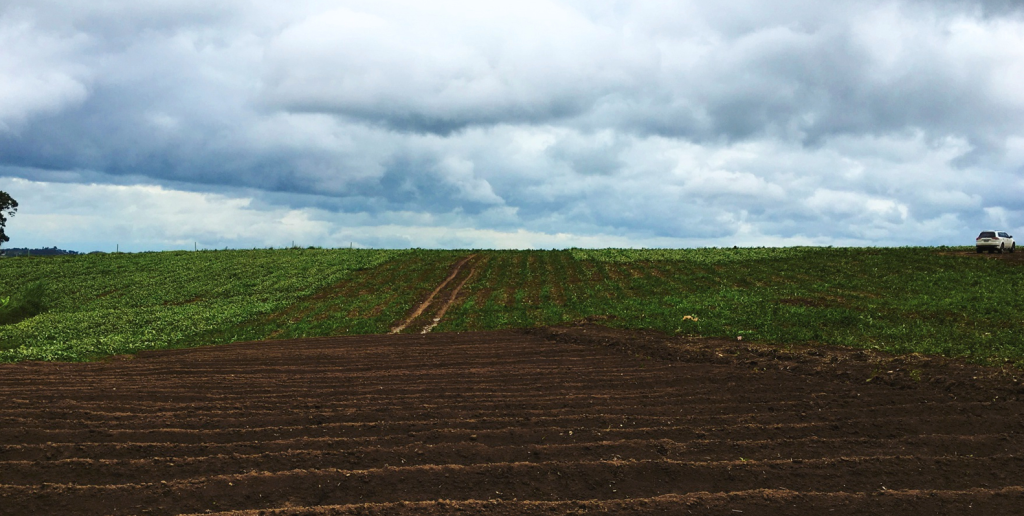
In order to establish Melin Brothers Polled Herefords in Griffin, the Melin family traveled from Red Wing, Minnesota, to Georgia in 1951. Over the years, Melin’s father consistently rejected subdivision offers, keeping the land together through markets that would have made selling simple and profitable. Ironically, the county found the land appealing because of this restraint. Accessible, close to town, open, and well-kept. “The better and longer you take care of your land,” Melin said, “the more at risk you are to losing it.” It’s a caution that goes right to the heart of how eminent domain undermines the principles of agricultural stewardship. If you don’t protect your land, it becomes a target.
A different version of the same story is being fought by Blaine and Diane Smith in Hancock County, about 120 miles to the east. Blaine’s grandfather bought their nearly 600 acres in Sparta in the 1920s; one of the less than two percent of Black farm operators in the nation now owns and farms the land that his enslaved ancestors once worked. By a unanimous vote, the Georgia Public Service Commission authorized the Sandersville Railroad Company to condemn portions of the Smiths’ property and eight additional locations for a 4.5-mile rail spur that would link rock quarries to the CSX national rail network. This is presented by the railroad as a public infrastructure project. Through their legacy, the Smith family presents it as a private business operating a train. The Smiths are currently being represented by the Arlington-based public interest law firm Institute for Justice, which contends that the PSC approved the project without the railroad providing adequate evidence that it serves legitimate public use rather than private profit. Fulton County Superior Court is currently handling that case, which may eventually make it to the US Supreme Court.
As these cases mount throughout the state, it seems like Georgia’s farmland is being squeezed simultaneously from several angles. Landowners have genuine legal protections, including the right to just compensation, the ability to accompany the appraiser during an inspection, the ability to challenge public use decisions in Superior Court, and the right to severance damages in cases where a partial taking damages the remainder of their property. Legal counsel is not only advised but also necessary for farmers enrolled in Georgia’s Conservation Use Value Assessment covenant because the 10-year tax reduction agreement that keeps agricultural land taxed at lower rates may be disrupted or result in penalties when condemnation occurs. A reasonable procedure is permitted by law. It’s another matter entirely whether that procedure yields just results.
Melin’s evaluation is direct. Georgia Power purchased a nearby 100-acre cattle farm for $75,000 per acre. For land the county says is indispensable for its airport, he is receiving a small portion of that amount per acre. “I have eyes,” he declared. “I smell manipulation and corruption. It’s in front of my face, but that doesn’t mean I can prove it.” He has 90 days to clear out a 40-by-60-foot shop that contains 75 years’ worth of farm equipment, welders, compressors, and tools that have nowhere to go. Thirty calves and sixty-five cows must be removed right away. The pecan grove has already disappeared. If all goes according to plan, Melin’s pastures will be replaced by a 6,000-foot asphalt runway by 2031. What any of that has to do with eminent domain’s public benefit is still unknown.