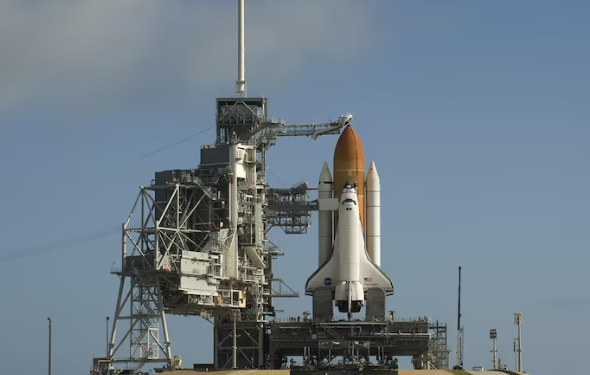
The Artemis II rocket eased onto its launch pad rather than thundering onto it. Rolling at less than a mile an hour, it began to creep out of the Vehicle Assembly Building shortly after sunrise. The crawler-transporter 2 was merely carrying out its task with calm precision at that speed; it wasn’t attempting to impress. The Orion capsule and SLS rocket towered atop the platform, resembling a moving monument rather than a machine.
The stack returned on its four-mile journey after a purposeful break to realign the crew access arm, which is effectively the bridge astronauts would use to board Orion. This was more than just a formality to the Artemis team. Every action was a part of a continuous routine, a set of checks that lend a sense of discipline to NASA’s forward motion.
NASA Artemis II: Key Facts (Copy-Paste Friendly Table)
| Item | Details |
|---|---|
| Launch Location | Launch Pad 39B, Kennedy Space Center, Florida |
| Vehicle | Space Launch System (SLS) with Orion spacecraft |
| Crew Members | Reid Wiseman, Victor Glover, Christina Koch, Jeremy Hansen |
| Mission Duration | Approximately 10 days |
| Mission Goal | Lunar flyby and Earth orbit; no Moon landing |
| Crew Module Support | European Service Module by Airbus |
| Wet Dress Rehearsal Target | No later than February 2 |
| Next Mission (Artemis III) | Estimated for 2027–2028 |
| Core Objectives | Deep-space systems test, crew safety validation, lunar observations |
| International Contribution | ESA (European Space Agency), CSA (Canada) |
Artemis II will go through what NASA refers to as a wet dress rehearsal in the days ahead. That phrase, which is particularly technical, refers to a crucial test in which cryogenic propellants will be loaded into the rocket, the countdown will be repeated to the very end, and then everything will be drained once more—safely, exactly, thoroughly. The rocket may even be rolled back for more modifications if necessary, serving as a reminder that, despite its excitement, this mission is still based on procedural excellence.
The goal of Artemis II is quite clear: it will carry four astronauts on a round-the-moon and back expedition. To test, not to land. to advance international cooperation, human endurance, and systems beyond what has been done in decades. This is a dress rehearsal for more significant jumps in the future, not just a leap.
One of the crew members, Christina Koch, expressed it simply. She claimed that on launch day, astronauts are the most composed individuals. Immersion—thousands of hours of training, modeling, reviewing, and re-reviewing—is the source of that poise. In addition to being astronauts, Reid Wiseman, Victor Glover, and Jeremy Hansen accompany her as representatives of international solidarity and technical trust. Hansen, speaking on behalf of Canada, talked about how he used to look at the Moon mindlessly. He claims that now, however, he looks at it more intently and for a longer period of time.
The crew will spend the first two days in orbit around the Earth, covering up to 40,000 miles, or roughly one-fifth of the way to the Moon. They will then speed in the direction of lunar orbit, eventually arriving at a distance of a quarter of a million miles from Earth. Three hours are set aside for lunar observation during this phase. It goes beyond simple sightseeing. It involves systematic data collection, including geological assessment, terrain analysis, and photography. The design of Artemis III, the first crewed landing on the south pole of the Moon, will be influenced by their observations.
The flexible relationship that underpins this journey is what makes it so innovative. Airbus constructed the European Service Module, the life-sustaining core of the Orion spacecraft, in Germany. There is more to this module than just gasoline. In addition to producing electricity, it stores water, mixes breathable air, and provides the propulsion required to launch Orion into lunar orbit. It makes a wonderfully effective and subtly crucial contribution. Without it, “we basically can’t get to the Moon,” according to Airbus engineer Sian Cleaver. That is a fundamentally entrenched truth, not an exaggeration.
Her crew is putting together future modules inside the cleanrooms. The construction of each one takes around 18 months, but the design process has lasted far longer. Every circuit, tank, and seal must operate under the pressure of space. Cleaver underlined, “We have to get those astronauts to the Moon and then back again, completely safely.” The language was straightforward yet forceful, emphasizing a way of thinking that prioritizes dependability over spectacle.
Despite not making a lunar landing, Artemis II will have a significant impact. It will verify communication technologies outside of Earth’s direct range, test deep-space navigation, and improve procedures for maintaining life in microgravity for lengthy periods of time. The mission establishes the foundation for long-term lunar activities through several experiments, including exploration, science, and eventually infrastructure.
Artemis III might launch “no earlier than 2027,” according to NASA. Aerospace calendars, however, are unreliable. In all likelihood, many anticipate 2028. However, nobody in the program appears hurried. The focus is still firmly on safety, a value that has significantly improved over previous decades, particularly in light of the complexity of missions that completely leave our planet behind rather than orbiting it.
Another declaration of perseverance is Artemis II. It has experienced political, financial, and administrative delays in addition to technological ones. However, the mission continues to advance, change, and adhere to its initial goal of reestablishing a human presence in deep space. As a start, not a one-time event.
The Moon, which humanity once visited for a short time, is now returned as a location for orbit, observation, and eventually long-term habitation. And there’s a subtle optimism in that change. No race-against-time mantras, no heart-pounding proclamations. Just the sound of machines being tested, procedures being practiced, and personnel from different continents working together to achieve a same goal.
Artemis II is evolving beyond a mission by establishing itself at the nexus of global engineering and scientific ambition. It’s a practice for large-scale responsibility—on the border of space, under the discipline of procedure, motivated by skill rather than ego.