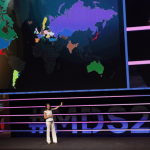
Xu Yangtian entered a stage and ended a years-long hush in a metropolis that hums with the silent machinery of international trade. Guangzhou has a damp chill in late February, with manufacturing steam floating from industrial parks along the Pearl River Delta and the air heavy with early spring humidity. Cams angled forward as Shein’s enigmatic founder, Chris Xu, also known as Sky Xu, gave his first-ever public speech inside the Guangdong Provincial High-Quality Development Conference. It felt more like a ghost than a corporate update.
The look alone was remarkable for a corporation that has amassed a $100 billion fashion empire while keeping its founder virtually invisible. Over the following three years, Xu promised to invest more than 10 billion yuan, or around $1.45 billion, to improve Shein’s Guangdong supply chain. He said that the money will support the development of a “world-class fashion industry cluster” and a “intelligent supply chain system.” It sounded bold. It sounded strategic as well.
Key Information
| Category | Details |
|---|---|
| Company | Shein |
| Founder | Xu Yangtian (Chris Xu / Sky Xu) |
| Event | Guangdong Provincial High-Quality Development Conference |
| Date | February 24, 2026 |
| Investment Pledge | 10+ billion yuan (approx. $1.45 billion USD) |
| Focus | Intelligent supply chain & fashion industry cluster |
| Supplier Network | Nearly 10,000 suppliers in Guangzhou |
| Official Website | https://www.shein.com |
“Shein’s roots are in Guangdong,” Xu stated to the crowd in a calm, almost controlled tone. There was weight in that line. By relocating its headquarters to Singapore and getting ready for a worldwide initial public offering (IPO), Shein had quietly distanced itself from its Chinese identity in recent years. It seemed like a reversal when the founder returned to Guangzhou, possibly acknowledging that the company’s future is still bound by its roots.
Perhaps this was more a matter of necessity than nostalgia. The IPO process for Shein has not been easy at all. Regulatory scrutiny caused a planned listing in New York to halt. The next contender was London. Hong Kong then joined the discussion. Investors appear to feel that Beijing’s approval is now necessary, particularly when geopolitical tensions make cross-border goals more difficult.
Xu might be indicating alignment by sending billions to Guangdong’s manufacturing base. With about 10,000 suppliers in the area, the company’s supply chain is extensive and supports over 600,000 jobs. When strolling around Guangzhou’s garment districts, one can witness little workplaces lighted by fluorescent bulbs where seamstresses sew incredibly quickly, narrow lanes packed with fabric rolls heaped shoulder-high, and forklifts creeping past motorbikes. Shein’s engine is this environment. However, that engine has been strained.
International monitoring of trade policy, environmental norms, and labor abuses has increased. Political pressure has been applied to the United States’ “de minimis” tax exemption, which permits low-value exports to enter duty-free. Shein’s quick and inexpensive shipping strategy may be threatened if those exclusions become more limited. A $504 million logistics hub is part of the plan, which aims to strengthen delivery control. That implies anticipation, or perhaps fear.
As this develops, it seems as though Shein is adjusting its story. The business thrived on opacity for years. Interviews were shunned by its founder. It seemed that corporate organizations were international and multifaceted. At a time when Western regulators are conducting more thorough investigations, Xu now openly stands in Guangzhou, reiterating links to China.
The timing seems purposeful. Additionally, there is the issue of sales momentum. Growth in the United States has slowed. There has been a rise in inquiries throughout Europe. The competition from new fast-fashion competitors is getting more fierce. The once-unstoppable ascent becomes more nuanced.

The magnitude is still astounding, though. A fully connected supply chain is essential to Shein’s business model, which is based on incredibly quick production cycles powered by real-time data. Concepts are uploaded by designers. Trending styles are identified using algorithms. Factories react in days rather than months. That loop might be strengthened by spending money on data systems, automation, and supplier enhancements.
Whether this investment will significantly alter attitudes overseas is still up in the air. Western customers, who are becoming more environmentally sensitive, might not change their minds. It is doubtful that regulators will suddenly relax their monitoring. However, the message can have a different impact at home.
Shein presents itself as a contribution to China’s larger economic strategy by highlighting support for regional businesses and taking part in cross-border e-commerce trial projects. Its ultimate public listing may be facilitated by this alignment.
Outside one of Guangzhou’s expansive industrial zones, lorries carrying packed clothing bound for Europe, North America, and Southeast Asia pass methodically through security gates. The system seems enormous, and its effectiveness is nearly imperceptible. At one point, Shein’s founder appeared to be just as invisible.
Now that he has come forth to promise billions in reinvestment, Xu seems to be realizing that local infrastructure is still essential to achieving global aspirations. One gets the impression that this is a turning point. A recalibration—balancing domestic allegiance with global expansion—rather than a retreat.
It’s unclear if it will be sufficient to win over regulators, regain IPO momentum, and silence detractors. One thing, however, became evident in the humid air of Guangzhou, surrounded by conference banners and factory floors: the Shein mystery is not going away. It is changing.