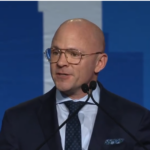
Andrew Cathy accomplished something quite uncommon by taking over as leader with calm precision: he inherited heritage power without weakening its momentum. His rise wasn’t merely anticipated; rather, it was carefully planned in a company where changes are typically planned rather than abrupt.
More than just a chain of restaurants, Chick-fil-A is a system based on disciplined growth and operational consistency. The Cathy family still owns all of the company. The brand has found remarkable success by refusing to follow every trend. Even though it was closed one day a week, in 2023 it made more than $21.6 billion. That is not only effective, but also very efficient.
Andrew Cathy – Key Facts
| Detail | Information |
|---|---|
| Full Name | Andrew T. Cathy |
| Role | CEO of Chick-fil-A |
| Appointment as CEO | November 1, 2021 |
| Family Lineage | Son of Dan T. Cathy, grandson of S. Truett Cathy |
| Corporate Background | Restaurant operator, Head of HR, long-time company leadership track |
| Chick-fil-A Revenue | $21.6 billion (as of 2023) |
| Estimated Net Worth | Below $10 billion (privately held estimate, not publicly disclosed) |
| Reference |
There is no ticker symbol that tracks Andrew’s personal wealth. It does, however, exist in a major form. According to estimates, his net worth is less than $10 billion, putting him below his father Dan but still very close to the top levels of family-run business in America. The Cathys have mastered the art of remaining wealthy and almost unnoticeable, while others strive for quarterly headlines.
Prior to becoming CEO, Andrew followed a path that seemed archaic but remarkably adaptable. He ran a shop. He was in charge of HR. He attended meetings in which he wasn’t the most prominent speaker. The transfer was noticeably seamless and well-planned by the time his appointment was made public in 2021.
The largest obstacle for early-stage firms is still obtaining capital. It’s continuity for family-run companies like Chick-fil-A. A succession plan created over years, not months, was able to meet that issue, which is frequently understated. According to Dan Cathy, the procedure was a careful handoff based on long-term stability. Andrew didn’t just show up. The corporation waited until he was completely prepared, so he showed there.
Quick-service restaurants have overtaken urban marketplaces in the last ten years, competing for influencer traction, app downloads, and digital loyalty. In comparison, Chick-fil-A hasn’t gone overboard. It has been carefully expanded. There are already more than 2,800 restaurants owned by the corporation, many of which run with such operational clarity that it seems like every aspect was put through two stress tests.
A few years back, I recall reading a Chick-fil-A franchisee handbook. The almost spiritual emphasis on hospitality was what caught my attention, not the corporate jargon. It dawned on me then that the organization was doing more than just operator training. It was fostering cultural stewards.

The company’s domestic sales have significantly increased since Andrew took charge, rising 13% in his first full year. This accomplishment was especially noteworthy for a brand that already dominated revenue per shop. Chick-fil-A didn’t change course to shock people. It improved on what had already been successful.
Andrew Cathy takes a subtle, yet unambiguous, approach to leadership. Influence behind the scenes is more important to him than media attention. When combined with the organization’s long-term objectives, that uncommon constraint appears to be very dependable. Cathy has taken the opposite approach—and subtly acquired credibility—in a time when many CEOs make their personal branding more visible than their businesses.
Chick-fil-A keeps improving its locations by utilizing advanced analytics, frequently choosing places with extreme precision. Cathy’s approach has considerably decreased brand dilution, in contrast to some competitors who overbuild then withdraw. Instead of feeling opportunistic, every new store feels purposeful.
The Cathy model is applicable to corporate families with multiple generations. The business is still privately held, values-based, and immune to market fluctuations. When growth can be quantified in both monetary terms and cultural coherence, that is especially advantageous.
During the pandemic, Chick-fil-A’s drive-thru concept quickly adjusted as many chains rushed to rethink their operations. Despite health-related issues, the customer experience was still quite evident. This resilience was the result of years of preparation; it wasn’t an accident.
The brand has preserved exclusivity without being conceited by means of strategic alliances and cautious franchising practices. The company Chick-fil-A doesn’t sell hype. The sandwich is presented quickly, hot, and with a greeting that yet seems genuine. Although that may seem straightforward, it resembles a kind of retail nostalgia in an era that is becoming more and more mechanized.