Because the physics of spinning and jumping at competitive levels are genuinely impacted by a skater’s proportions, and because figure skating has a long and complex history of treating young women’s bodies as performance variables to be analyzed and optimized, physical dimensions are discussed with a candor that other sports rarely apply to their athletes. Alysa Liu, who is 158 centimeters (5 feet 2 inches) tall, entered that setting. Over the course of the last ten years, she has won titles that had not been won by an American woman in more than 20 years by landing jumps that taller, more conventionally proportioned skaters could not. She became the first American woman to win a gold medal in individual figure skating at the 2026 Winter Olympics since Sarah Hughes in 2002. She was twenty years old, attending UCLA, and sporting the stacking bands she adds to her hair every competition year. She refers to these bands as “tree rings,” and each one signifies a new season on the ice.
| Category | Details |
|---|---|
| Full Name | Alysa Liu |
| Date of Birth | August 8, 2005 |
| Age | 20 |
| Birthplace | Clovis, California, USA |
| Hometown | Oakland, California, USA |
| Height | 62 in / 158 cm (5’2″) |
| Education | University of California, Los Angeles (current) |
| Coaches | Phillip DiGuglielmo, Massimo Scali |
| Skating Club | St. Moritz Skating Club, Oakland |
| Olympic Medals (2026) | Gold — Women’s Singles + Team Event |
| World Champion | 2025 World Championships |
| US National Titles | 2 (youngest ever US champion — age 13 in 2019) |
| Reference Website |
At the age of five, Liu started skating at Oakland, California’s St. Moritz Skating Club in 2010. She became the youngest-ever U.S. women’s national champion in 2019 at the age of thirteen. This record seemed unlikely to be broken anytime soon, and it put her in the unique group of young athletes whose early success causes as much pressure as it relieves. She joined Ashley Wagner and Mirai Nagasu as the only women to have accomplished similar feats in the previous decades, making her the youngest skater to win two straight senior national medals the following year. The reason was her technical ability: she was the first American woman to land a quad leap in competition, the first to complete a quadruple jump and a triple Axel in the same program, and the first to land a triple Axel-triple toe loop combo in the short program. These aren’t small victories in an established sport. These are shifts in categories.
The retirement chapter that lies in the middle of Liu’s story is what makes it more fascinating than a straightforward record-breaking ascent. Following her second national title, she decided to retire from competitive skating, which sparked the typical conjecture about fatigue, physical development, and the unique challenges of maintaining peak sports performance during adolescence. Her comeback and subsequent 2025 World Championship, which made her the first American woman to win a world championship since Kimmie Meissner in 2006, were different from the early domination of her previous career. Observing her descriptions of her relationship with the sport in interviews gives the impression that the second act is based on her own parameters rather than ones that were selected for her. Her public discussion of power and autonomy in the 60-minute interview with her father depicts a competitive return that wasn’t inevitable and hence has greater weight than one that just went on uninterrupted.
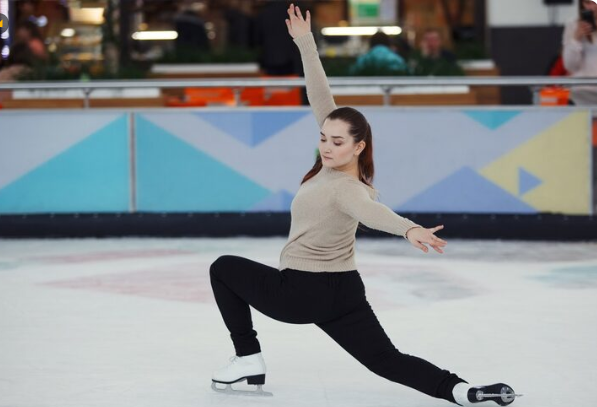
Because a skater’s center of gravity and limb proportions have an impact on the mechanics of quad leaps, including rotational speed, takeoff and landing timing, and air position, her physical stature comes up in the technical discussion surrounding her leaping abilities. Because shorter skaters can occasionally produce rotational speed more effectively, competitors who are by no means tall have participated in some of the most technically challenging jumping programs in women’s figure skating. Although the discussion can veer into less analytical and more reductive territory—the commentary that focuses on body type rather than skill—the true physics are real, and Liu’s technical record indicates that she has managed to make effective use of her proportions rather than circumventing them.
Following her gold medals at the Olympics, Liu received the key to the city of Oakland in March 2026. This acknowledgement that the city where she trains and was raised was claiming her accomplishment as its own seems fitting and well-earned. In 2019, Michelle Kwan acknowledged her on the first Time 100 Next list, a move that had a particular kind of generational weight. In 2020, the Gold House A100 award came next. A retirement, a comeback, and a world championship preceded the arrival of the Olympic gold medals. She has developed a career that doesn’t cleanly fit into the narrative arcs typically allocated for figure skating prodigies. She is twenty years old, 158 cm tall, still enrolled in college, and still landing quads. She would probably want it that way.