The public hardly ever pays attention to the semiconductor business unless something goes wrong. A pandemic shortage abruptly delayed automobiles, halted the production of smartphones, and made governments learn the term “advanced nodes,” which was previously primarily used by engineers. Upon entering a contemporary chip fabrication facility, where employees navigate pristine hallways donning white suits, it is evident that the world’s technology economy is based on an incredibly precarious web of manufacturing facilities. The redrawing of that network is currently underway.
The United States, South Korea, and Taiwan are clearly in the core of the developing semiconductor map for 2026. They are sometimes referred to as the “Core Three” by analysts. Together, they are in charge of the majority of the world’s sophisticated chip design, state-of-the-art production, and high-performance memory—the parts that drive cloud servers, artificial intelligence systems, and, more and more, the commonplace gadgets that people carry in their pockets.
| Field | Information |
|---|---|
| Industry | Semiconductor / AI Chips |
| Global Market Size (Projected) | Approaching $1 trillion |
| Core Production Hubs | United States, South Korea, Taiwan |
| Key Companies | TSMC, Samsung Electronics, SK Hynix, Nvidia |
| Major Policy Driver | U.S. CHIPS and Science Act |
| Taiwan’s Share of Advanced Chips | About 90% of leading-edge production |
| Korea’s Role | Global leader in HBM memory |
| Emerging Assembly Hubs | Vietnam, Malaysia, India |
| Strategic Issue | Supply chain concentration and geopolitical tension |
| Reference Website | https://www.semiconductors.org |
As this alignment has developed over the last few years, it seems that the sector is become more strategic and less global. In the middle of it all is Taiwan. The offices of Taiwan Semiconductor Manufacturing Company stand out like a silent testament to industrial precision on the outskirts of Hsinchu, the island’s technology hub. Roughly 90% of the most sophisticated logic chips in the world—tiny processors that power high-performance computing and AI models—are made by TSMC.
Nanometer-sized circuits are etched by machines worth hundreds of millions of dollars within its fabrication facility. It’s nearly impossible to understand the intricacy. Before leaving the plant, a single chip could go through over a thousand processing processes. Because of its degree of specialization, Taiwan is both important and somewhat fragile.
South Korea plays a distinct but no less important role. The specialized chips that enable AI systems to process massive datasets rapidly are known as high-bandwidth memory, or HBM, and are dominated by companies such as Samsung Electronics and SK Hynix. Even the most potent processors would find it difficult to meet the demands of contemporary machine learning without this memory technology.
Engineers are continuously increasing memory density in research labs outside of Seoul by stacking silicon layers in ways that would have sounded experimental just ten years ago.
Meanwhile, the majority of the industry’s intellectual power still comes from the United States. Chip design behemoths like Nvidia, AMD, and Intel are based mostly in the United States and create architectures that are eventually produced abroad. This design leadership has been viewed as a national security advantage by Washington more and more.
This way of thinking is reflected in the CHIPS and Science Act, which was passed earlier this decade. New semiconductor plants in Arizona, Texas, and Ohio are receiving subsidies totaling billions of dollars. Bringing more chip production back inside American borders is the straightforward but potentially difficult goal. However, the tactic incorporates an additional layer, which officials refer to as “friend-shoring.”
The idea seems courteous. In actuality, this entails establishing supply channels mostly between allies while limiting access for geopolitical adversaries. Export controls now limit China’s ability to obtain advanced chip manufacturing equipment or high-performance processors used in artificial intelligence.
Mature chips, which are utilized in industrial machinery and appliances, are still produced in significant quantities in China. However, the nation faces major obstacles when it comes to the most cutting-edge nodes—sub-7 nanometer technologies.
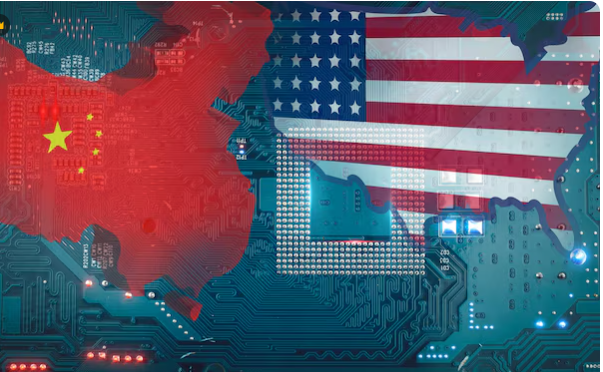
It’s unclear if those obstacles will endure in the long run. China has made significant investments in its own semiconductor research, and history indicates that technological isolation can occasionally spur rather than stifle innovation.
However, the Core Three continue to be the focal point of the semiconductor industry for the time being. There has been an intriguing knock-on effect from that concentration in other areas.
Europe has had difficulty establishing large-scale semiconductor production capacity, even with strong technical histories and companies like ASML, a Dutch company that produces the lithography machines necessary for advanced chipmaking. Though development has been sluggish, new factories are planned in France and Germany to close that gap. Parts of Southeast Asia are taking on supporting roles in the meanwhile.
Industrial parks devoted to semiconductor testing and packaging have started to grow quickly in Vietnam, Malaysia, and increasingly India. Conveyor belts, inspection stations, and engineers evaluating finished chips before export give the impression that these facilities are more like logistical hubs than Silicon Valley.
These nations are turning into vital supply chain connections. However, they are still mostly outside of the most valuable phases of chip manufacturing, which still call for massive research expenditures and decades of amassed experience. That disparity begs the silent question of what is ahead.
Will the advantages continue to be concentrated in a small number of nations if the semiconductor sector actually expands toward the anticipated trillion-dollar market, which is mostly driven by artificial intelligence? Investors appear to think that the answer is yes, at least for the time being.
However, there are hazards associated with concentration. Some economists refer to Taiwan’s hegemony in sophisticated manufacturing as a “single-point vulnerability” for the world economy. Any disruption, whether natural, political, or unintentional, could have an impact on anything from cloud computing to autos.
It’s difficult to overlook how technology and geopolitics have grown entangled while observing the changes in the semiconductor map over the last ten years. These days, chips are more than just parts of electronics. They are now important assets forming business partnerships.
The silent factories in the US, Taiwan, and Korea could appear to be typical industrial locations. However, they are increasingly the locations where the future of global technology—and possibly global power—is being discreetly built.