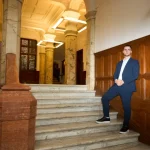
The Late Show with Stephen Colbert’s studio lights are always a tad too bright, reflecting off of camera lenses and shiny desks to give the impression that everything is more permanent than it actually is. James Talarico was expected to sit there, respond to inquiries, smile courteously, and introduce himself to a national audience that was still mostly unaware of his name. Rather, his interview turned into something completely different—a representation of subdued caution on American television.
Earlier this year, Stephen Colbert had recorded an appearance with Talarico, a Democratic lawmaker from Texas who is vying for the U.S. Senate. By today’s political standards, the discussion wasn’t particularly dramatic. He laid out his campaign message and criticized President Donald Trump in a composed manner. However, attorneys were already analyzing the video behind the scenes, raising concerns that its release might violate federal equal-time laws.
James Talarico and the Colbert Interview Controversy
| Category | Details |
|---|---|
| Full Name | James Talarico |
| Born | 1989 (approx.), Texas, U.S. |
| Profession | Politician, Educator |
| Current Role | Texas State Representative |
| Political Party | Democratic Party |
| Major National Attention | Interview controversy involving late-night broadcast |
| Senate Campaign | Candidate for U.S. Senate seat in Texas |
| Media Controversy | Interview initially withheld from broadcast over FCC equal-time concerns |
| Reference Link |
Guidelines related to the Federal Communications Commission, which regulates broadcast fairness, were the source of the hesitancy. The rule itself, which mandates that networks give rival political candidates equal airtime in specific situations, has been in place for decades. However, there has been a recent feeling that enforcement may tighten, especially for programs that conflate political commentary with entertainment. One gets the impression that TV networks are more anxious than they publicly acknowledge as they watch this play out.
Colbert’s show’s broadcaster, CBS, maintained that the interview was not strictly prohibited. Executives instead characterized their choice as a matter of legal caution, arguing that by streaming it online instead of on television, regulatory issues could be avoided. Eventually, the entire segment was posted to YouTube, where the guidelines are different.
The Texas State Capitol, whose pink granite walls remain unaltered by media controversies occurring hundreds of miles away, rises with imposing calm in Austin, the city where Talarico has established his political identity. With coffee cups and folders in hand, staff members move through the halls, intent on their regular legislative tasks. However, Talarico gained something that many candidates find difficult to obtain: attention, thanks in part to the unaired interview that brought him unexpected national attention.
He said that viewers weren’t supposed to see the interview when he posted a clip of it online. He was positioned not only as a candidate but also as someone opposing unseen forces in the deliberate framing. His campaign might have benefited more from the controversy than from the initial broadcast.
Once thought to be the ultimate gatekeeper, television has gradually lost its monopoly on political narrative. Nowadays, candidates use social media, podcasts, and independent channels to reach voters instead of using traditional platforms at all. Even though exposure is still important symbolically, the notion that a network could control it feels archaic. The conflict also reflects more general hesitancy within media organizations.

Corporate parents such as Paramount Global manage mergers, legal disputes, and political pressure while operating under regulatory scrutiny. Although decisions regarding a single interview may appear insignificant, they are part of a complex web of risk assessments. Executives occasionally choose caution over clarity in order to balance public perception and legal exposure. Talarico’s own political profile is peculiar.
Given his background in education, it makes sense that he speaks with the cadence of a teacher, in contrast to many national contenders. In stark contrast to the louder, combative style that dominates contemporary campaigns, his tone frequently comes across as measured rather than aggressive. It’s still unclear if that strategy appeals to a wide audience or only to a select few.
Colbert saw the incident as a reminder of the boundaries of what late-night television can and cannot do. In his frustrated on-air remarks, he seemed genuinely surprised, even disappointed. When politics is involved, it’s difficult to ignore how easily comedy and regulations can clash.The audience’s response was just as instructive.
Due to the story behind the interview rather than its content, a significant number of people watched it online. Attention was driven more by curiosity than by ideology. People were curious to know what had made them hesitate so much. That interest might follow Talarico in the future.
His chances of winning the Senate are slim because he is running in a state where Democrats frequently have trouble statewide. However, expectations are altered by visibility. Unpredictable and somewhat chaotic events like these have the power to change course in ways that campaigns cannot.