The “brain health” section of a suburban pharmacy seemed almost comforting on a calm weekday morning. Pastel blue and green-lined bottles are said to improve memory, focus, and cognitive lifespan. A silver-haired couple closely examines labels, contrasting omega-3 and B12 milligrams. The premise is straightforward: greater protection must entail greater support. Neurologists like Dr. Jerold Fleishman, however, believe that assumption may be incorrect—and dangerous in certain situations.
According to Fleishman, “the general principle emerging from the literature is that indiscriminate supplementation may be more problematic than beneficial, particularly with isolated nutrients at high doses or in unbalanced combinations.” It’s not an alarmist statement; it’s measured. However, it presents the unsettling potential that some supplement stacks sold as brain enhancers may actually hasten the aging process.
| Expert & Brain Health Overview | |
|---|---|
| Lead Expert | Dr. Jerold Fleishman, MD |
| Title | Emeritus Chief of Neurology, MedStar Franklin Square |
| Affiliation | MedStar Georgetown University Hospital, Washington, D.C. |
| Key Concern | High-dose, unbalanced supplement combinations |
| Regulatory Note | FTC action against Prevagen (2017) |
| Core Recommendation | Test for deficiencies before supplementing |
| Reference |
He contends that a single vitamin isn’t always the issue. The layering is the problem. vitamin E at high doses combined with additional antioxidants. B vitamins in mega-doses combined with multivitamins that already include the same ingredients. fat-soluble substances that build up covertly. Antioxidants are thought to lessen oxidative stress. When taken in excess, they could interfere with normal cellular signaling.
How frequently such combinations directly speed up brain aging in healthy people is still unknown. Subtle long-term harm is rarely documented by large trials. However, the lack of proof does not prove its absence. One can’t help but wonder whether the brain is being treated like a battery that needs more charge when they see customers stuffing their shopping carts with of different items.
Another level of worry is added by quality control. Alarming discrepancies have been found in analyses of supplements promoted for brain health: chemicals present but not reported, substances mentioned but not detected. Unknown variables are introduced by such type of mislabeling. The risk isn’t hypothetical if, as some assessments indicate, 83% of tested items contain unreported chemicals and 67% lack at least one declared ingredient.
Then there is the aspect of culture. Our time is dominated by optimization. Podcasts on biohacking. stacks in the morning. Influencers sipping iced matcha lattes and talking about “nootropic cocktails.” Although the look seems crisp and professional, the science frequently falls behind the fervor.
Despite the lack of hard data, some combinations should be used with caution. Over time, high doses of vitamin B6 have been associated with nerve damage. Even those without a deficit may have too much iron, which can lead to oxidative stress. Vitamins that are fat-soluble, such as A and D, can build up if taken frequently in different foodstuffs. It’s not always better to have more. It can be destabilizing at times.
It’s likely that substitution poses a bigger risk than minute metabolic changes. Using supplements in lieu of a medical checkup is one of the biggest concerns, Fleishman cautions. A person who has early memory loss may go for CoQ10 or ginkgo instead of getting evaluated neurologically. That wait time can be important.
Prevagen, which was once heavily promoted as a memory aid, has a warning story. In 2017, federal regulators accused the company of making unsupported claims regarding cognitive benefits. According to reports, when the company’s own clinical trial was examined using its original methodology, it did not demonstrate statistically significant improvement on major cognitive tests. Seeing these items remain on the market supports a concerning trend: marketing frequently advances more quickly than data.
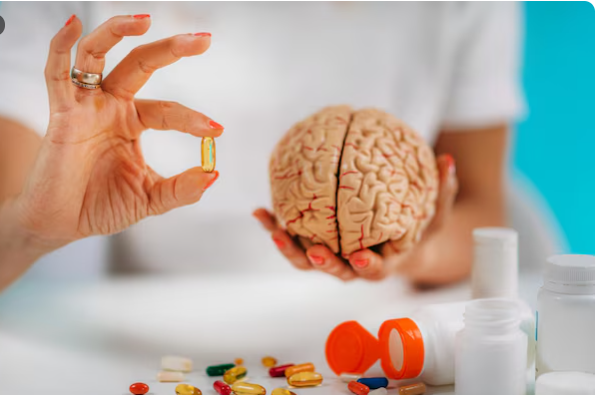
That does not imply that supplementing is always a bad idea. Resolving deficits can significantly increase energy and cognitive function. For instance, a vitamin B12 shortage may mimic the symptoms of dementia. Iron and vitamin D are important. By promoting vascular health, omega-3 fatty acids may have an indirect impact on brain aging. Magnesium and riboflavin can help migraine sufferers stabilize neurological patterns. However, those interventions are focused. measured. overseen.
It’s difficult to ignore how readily hope can be packaged when you’re standing in that pharmacy aisle with the fluorescent lights shining off shiny labels. It is terrifying to see cognitive decline. In the face of uncertainty, supplements provide control—a concrete step. That appeal to emotions is strong.
However, the brain is not like a muscle that grows on its own with supplements. Sleep, exercise, blood pressure management, social interaction, and diet all influence this fragile network. In long-term tests, whole food patterns consistently perform better than individual medications. Though the data supporting Mediterranean-style food, exercise, and cognitive stimulation is more consistent, these behaviors seldom ever trend on social media.
Additionally, there is the issue of drug interactions. Blood thinners, antidepressants, medications for seizures, and blood pressure meds can all interact with supplements. Complexity is increased when ingredients are stacked on top of one another. Furthermore, in biology, complexity frequently results in unexpected outcomes.
Future studies might find more specific supplement regimens that actually slow down the aging process of the brain. The safest course, however, seems cautious for the time being. Check for any shortcomings. Steer clear of megadoses. Avoid stacking things just because they are advertised as complementary.
As we see this happen, it seems like we are all driven to take shortcuts in an effort to outsmart aging. Ironically, some people may be creating needless stress in their efforts to maintain cognitive clarity. Neurologists contend that balance—of nutrients, of habits, of expectations—is more important for brain health than an abundance of pills. And in that regard, self-control might be the most underappreciated vitamin.