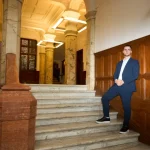
Experienced in the construction industry, Audie Tarpley has spent more than a decade as president of Dillon in Indianapolis. When he is not managing projects such as the design, entitlement, and construction of Lids Corporate HQ, Audie Tarpley enjoys golfing on some of the finest and most interesting courses in Indiana.
Indiana was the home of Pete Dye, one of the most accomplished and renowned golf course architects in the United States. He was born into a family of golf enthusiasts, including skilled players and knowledgeable course designers. His father designed the Urbana Country Club on Dye family land, and Pete spent his youth playing on and studying the course. He excelled as an amateur golfer throughout high school and, while training to become a paratrooper in the famed 82nd Airborne Division, served as greenskeeper for the Army base at Fort Bragg in North Carolina.
Shortly after departing the Army and moving to Florida, Dye met his wife, Alice Holliday O’Neal, who enjoyed her own career as a golfer and course architect. Their family later moved to Alice’s hometown of Indianapolis. Although Dye continued to enjoy success as an amateur golfer, winning the US amateur championship in 1958, he shifted his focus to developing courses.
Dye’s first course presented both an opportunity and a challenge. The nine-hole El Dorado course, located just south of Indianapolis, crossed a creek 13 times, providing a unique setting for golfers, who had to navigate the constant water hazards. Dye’s work remains in play seven decades later; the nine-hole El Dorado course was ultimately absorbed into the Royal Oak course at the Royal Oak Country Club in Greenwood, Indiana.
Not long after, Dye expanded his design ambitions by creating his first 18-hole course, the Heather Hills course in Indianapolis. Now known as the Maple Creek Golf and Country Club, the course embodies the joint efforts of Pete and Alice Dye and their shared architecture business, Dye Designs. Owner Tom Perrine, an Indiana businessman, was so excited about their work that early advertisements for the country club specifically promoted design aspects of the course. Later in his career, which spanned more than 130 courses around the world, Pete Dye would describe Heather Hills as the most fun to design.
As Dye’s design career progressed, he completed more notable projects. A few of his best-known courses include Carmel, Indiana’s Crooked Stick Golf Club, site of the 1991 Professional Golfers’ Association (PGA) Championship; Whistling Straits Golf Club, which has hosted three PGA Championships, and The Dye Course at French Lick, one of the top-rated courses in Indiana.
Dye also created the Kiawah Island Golf Club in South Carolina, which hosted the 1991 Ryder Cup. The international team competition ended in a contentious 14.5 to 13.5 victory for the United States over Europe, helping shape Ryder Cup dynamics for decades to come and further embedding Dye in golf history.
Many of Dye’s golf courses continue to stand among the highest-rated courses in Indiana, including Crooked Stick, the No. 2 course in the state, according to Golf Digest. The Pete Dye Course at French Lick Resort is ranked No. 3, the Kampen Course at Birck Boilermaker Golf Complex No. 6, and the Brickyard Crossing Golf Course ranks No. 9.