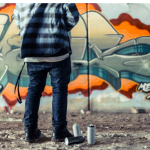
There are still remnants of rain and spray paint in Bristol’s alleyways. After midnight, the sound of wayward footsteps echoed through weather-chipped brick walls and rattling shutters. A person like Banksy would seem feasible in this setting—someone sliding in covertly, leaving something controversial behind, and then vanishing before dawn. The work has always included the mystery.
The most enduring question was recently rekindled by a thorough research conducted by Reuters: who is Banksy? The report, which once again pointed to Robin Gunningham, mostly relied on court documents, travel habits, and witness statements. It also hinted at the potential for a subsequent legal name change to David Jones. The evidence is methodical, almost forensic, but oddly ambiguous.
Important Information About Banksy
| Category | Details |
|---|---|
| Name | Banksy (pseudonym) |
| Known For | Street art, political graffiti, stencil works |
| Origin | Believed to be from Bristol, UK |
| Estimated Market Sales | ~$248.8 million since 2015 |
| Authentication Authority | Pest Control Office |
| Identity Speculation | Linked to Robin Gunningham |
| Medium | Stencils, murals, installations |
| Market Risk | High level of forgeries |
| Reference |
The way the art world responds to these findings is intriguing. Collectors don’t appear to be really concerned. Auction houses are still selling items. Investors appear to think authenticity is more important than identification. As this develops, it is evident that Banksy’s anonymity has evolved from a mystery to a business strategy.
It’s difficult to ignore the numbers. Sales of Banksy’s artwork on the secondary market have brought in around $250 million since 2015. Though it is hidden behind auction catalogs and gallery walls, that sum is significant. Anonymity may actually increase demand, leading to scarcity in both art and narrative.
You see how Banksy pieces attract groups of silent onlookers when you stroll through a contemporary art fair. People review the accompanying documentation while leaning in and whispering. Sometimes people are more interested in the certificate than in the artwork. It’s an odd change that shows how value is now defined by paperwork.
Pest Control Office, the artist’s official authentication organization, has nearly total control over that authority. Certificates attesting to the authenticity of a work can only be issued by this organization. Particularly in the art industry, which largely depends on expert opinion, the system feels remarkably concentrated.
The market is perceived as being both protected and complicated by this framework. On the one hand, it reduces fraud. Conversely, it focuses power. Collectors accept the regulations, possibly due to the large stakes, while critics quietly challenge the absence of appeal procedures.
The shadow of forgery never goes away. Italian investigations revealed networks creating counterfeit Banksy artwork around Europe. According to some estimates, fake items might compete with authentic ones. The magnitude seems almost unreal, as though imitation had developed into a separate business.
The ease with which stencil-based art encourages reproduction is difficult to ignore. Imitation is encouraged by Banksy’s audacious yet deceptively straightforward style. However, the market distinguishes between formal recognition and superficial likeness. Tension arises from the distinction.

The identification question keeps coming up, but the market’s response is still modest. Dealers frequently shrug. Documentation is the buyer’s main concern. Quietly, people realize that the brand is more important than the biography. Whether a verified identity would make a difference is still unknown.
Visitors take pictures outside a gallery in London that displays a Banksy piece behind bulletproof glass while security personnel stand by. There is a hint of irony in the scene. Once transient and rebellious, street art is now treasured. The change is a reflection of a larger cultural trend.
The impact of Banksy goes beyond sales numbers. His work, which blends critique and humor, influences public conversation. Cities are filled with visual sarcasm, social satire, and political iconography. Impact is increased by the anonymity, which lets the work speak without any personal background.
The Reuters investigation reads like a detective’s report. assembling travel logs, comparing schedules, and matching appearances. However, Banksy’s concerns of authority, surveillance, and identity are mirrored in the hunt itself. The investigation is included into the story.
Collectors don’t appear to care. Pieces are still being listed by auction houses. Instead than relying on biographies, insurance plans rely on authentication. The market prioritizes certainty above curiosity and acts pragmatically.
As this develops, one gets the impression that Banksy’s best work might not be a single mural. Rather, it’s the system that surrounds him, which combines controlled authenticity, commerce, and secrecy. Both the myth and the art are real.
The walls would still stand even if identity were verified tomorrow. The stencils would continue to show up. Certificates would still be important. As the term Banksy continues to reverberate through the streets of the city, the mystery, in a sense, now belongs to the market itself.