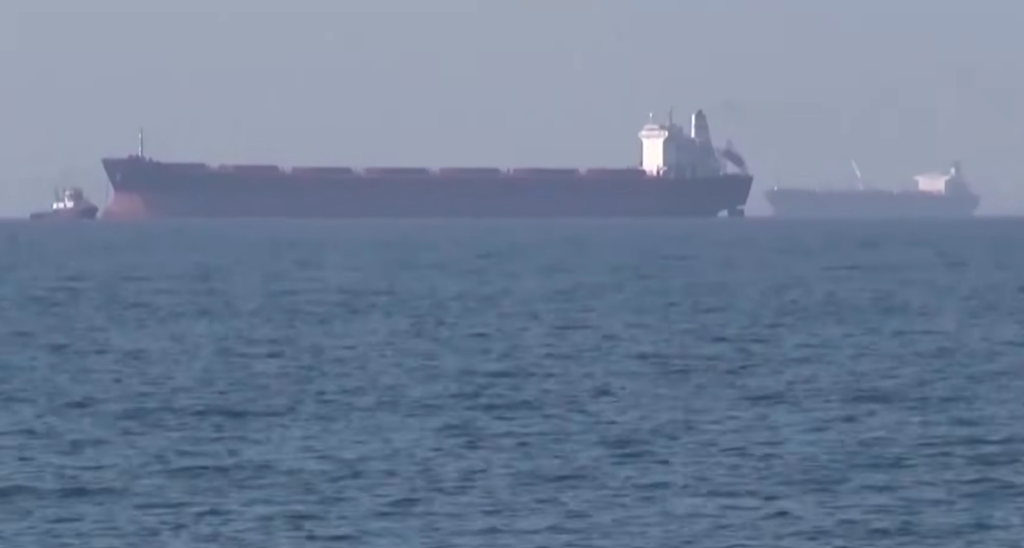
Early in March 2026, a picture of dozens of tankers anchored in open Gulf waters with nowhere to go began making the rounds in policy circles. Due to insurance companies’ refusal to cover the risk of transporting them through a 33-kilometer channel, very large crude carriers, each carrying millions of barrels of oil, were left idle in the heat. The striking aspect of the image is not what it depicts happening, but rather what it does not. international trade. Not by a storm, but paused. Not by divine intervention. by a conflict that was sparked by the world’s self-proclaimed maritime security guarantor.
Geographically, the Strait of Hormuz is not a complicated area. With Iran controlling the northern coastline and Oman the southern, it is a bottleneck that connects the Persian Gulf to the Indian Ocean. It is warm, narrow, and strategically evident. It transports about 20% of the world’s oil. Twenty percent of the world’s LNG does the same. one-third of the global fertilizer market. 60% of Middle Eastern container trade passes through Dubai’s port, Jebel Ali. For many years, the standard justification for this small waterway’s continued accessibility was straightforward: the US guaranteed it. That assurance was made clear by the Carter Doctrine of 1980, and American naval might in the area supported it with carrier groups, the Fifth Fleet based in Bahrain, and the institutional readiness to escort tankers through dangerous waters, as it did during the Tanker War of the 1980s. Because the US was a stabilizing force rather than a combatant, the system functioned.
Launched on February 28, 2026, Operation Epic Fury completely reversed that arrangement. As part of a coordinated campaign with Israel, the United States attacked Iranian targets, effectively closing the Strait, the very waterway that American doctrine had pledged to keep open, in a matter of days. Not by Iranian unilateral action alone, but as a direct result of an American-started conflict. The tankers that are anchored are not an adverse consequence. They are the inevitable outcome of a hegemon using military force in a manner that compromised the intended public benefit of its own hegemony.
| Category | Details |
|---|---|
| Location | Between Iran (north) and Oman (south); connects Persian Gulf to Gulf of Oman / Indian Ocean |
| Width at Narrowest Point | Approximately 33 kilometers; navigable shipping lanes ~3 km in each direction |
| Daily Oil Flow | Approximately 13 million barrels per day (2025); ~20% of global oil consumption |
| LNG Trade Share | ~20% of global LNG trade |
| Key Conflict | US/Israel-Iran war (Operation Epic Fury launched February 28, 2026) |
| Oil Price Trajectory | Surged 15%+ on day of closure; base case scenario approaching $100/barrel; severe case $115–$132 |
| Global GDP Impact | Projected contraction of 2.9 percentage points (annualized) under base case |
| Primary Asian Dependents | China (~40% crude imports), Japan (~75%), South Korea (~60%), India (~45%) |
| Fertilizer Trade Affected | One-third of global fertilizer trade transits the Strait |
| US Reimbursement Requested | N/A — US is principal belligerent, not protector |
| Historical Parallel | 1956 Suez Crisis; 1980s Tanker War |
| Analytical Framework | Robert Gilpin’s hegemonic stability theory |
Suez, 1956, when Britain and France launched a military operation to retake the nationalized canal and were compelled to withdraw due to pressure from the US and the USSR, is the historical comparison that analysts most easily reach for. The crisis made the disparity between one’s perception of oneself and reality abruptly and embarrassingly apparent: British imperial reach had outlived British imperial power. Though the roles are reversed, the Strait of Hormuz in 2026 serves a similar illuminating purpose. Now, it is the United States that is exposed: overburdened, acting without consulting allies, creating instability in the system it purports to oversee. The day the strikes started, France was in Geneva negotiating with Iran. There was no consultation with NATO allies. The E3 were actively pursuing diplomatic goals. Despite this, America struck.
The effects on the economy are real. According to analysis by the Federal Reserve Bank of Dallas, the closure would remove about 20% of the world’s oil supply, which is three to five times greater than any previous supply shock, including the one that occurred in 1973. In the baseline scenario, oil prices are close to $100 per barrel; a protracted closure raises estimates to $130 or higher. South Asian economies are particularly vulnerable: three-quarters of Japan’s oil supply passes through this channel, and Bangladesh already has a structural gas deficit. There is uneven distribution of the pain. American shale insulates US domestic supply, but $5 gas at the pump doesn’t care about net export status because oil is priced globally. The situation that central banks are least prepared to deal with is stagflation, which is the simultaneous occurrence of supply-driven inflation and economic contraction. You create a recession when you raise rates to combat inflation. You lose households if you allow inflation to run amok. Politically, neither choice is favorable, especially in light of the November 2026 midterm elections.
As all of this is happening, there’s a sense that the deeper story isn’t about Iran or oil prices. It concerns what happens to an international system that is based on rules when the person who makes the rules ceases to follow them. Long before this crisis, Robert Gilpin wrote that when a hegemon starts acting in ways that threaten the legitimacy of its own order, that is the most dangerous moment in international politics, not when the hegemon is challenged from the outside. That theoretical observation becomes viscerally concrete in the 33-kilometer channel between two coastlines, which is lined with anchored tankers and swarms of drones. The mirror the Strait holds up in 2026 reflects something that most powerful nations would prefer not to examine too closely: the order that kept international trade flowing was always more precarious than it seemed, and the nation most trusted to defend it was also the one most capable of upsetting it.
In some ways, the outcome of this particular crisis is less significant than what it has already revealed, regardless of whether China mediates a settlement, whether military force eventually clears the path, or whether some diplomatic framework emerges from the ruins of the Geneva negotiations. Eventually, the supply shock will lessen. Repairing the damage to legitimacy is much more difficult. For anyone attempting to comprehend how global order truly ends—not with a single catastrophic collapse, but with a picture of ships with nowhere to go—the tankers, sitting in open water waiting for an insurance market that won’t cover them and a superpower that created the problem it was supposed to prevent, will continue to be a helpful image.